
Introduction
Starting a new business in India is an exciting step, but choosing the right business structure and completing the registration correctly can feel confusing. Whether you are starting a technology startup, consulting business, trading company, manufacturing unit, or a professional service, proper registration gives your business a legal identity and creates a stronger foundation for future growth.
The new company registration process in India is largely completed online through the Ministry of Corporate Affairs (MCA). However, the documents, eligibility requirements, and incorporation procedure can differ depending on whether you choose a Private Limited Company , One Person Company Registration (OPC), or Limited Liability Partnership (LLP).
This guide explains the new company registration process step by step, including the documents required, registration options, government forms, estimated timelines, costs, and common mistakes to avoid.
What Is New Company Registration?
New company registration is the legal process of establishing a business entity under the applicable Indian business laws and obtaining recognition from the government.
For companies incorporated under the Companies Act, 2013, the registration process is handled through the MCA’s online system. Once incorporation is approved, the entity receives a Certificate of Incorporation and a Corporate Identification Number (CIN).
The exact procedure depends on the structure selected.
Common options include:
- Private Limited Company Registration
- One Person Company Registration
- Limited Liability Partnership Registration
- Public Limited Company Registration
- Section 8 Company Registration
For most small and medium-sized businesses, private limited company registration is one of the most commonly considered structures because it provides a separate legal identity and limited liability to its shareholders.
Which Business Structure Should You Choose?
Before beginning the new company registration process, it is important to select the appropriate business structure. The best option depends on the number of founders, investment plans, liability concerns, compliance requirements, and long-term business objectives.
Private Limited Company Registration
A Private Limited Company is suitable for businesses that want a separate legal identity and may eventually raise funds, bring in investors, or expand their operations.
A private company generally requires at least two members and two directors, subject to applicable legal requirements.
Key advantages include:
- Separate legal entity
- Limited liability of shareholders
- Better credibility with customers and investors
- Easier transfer of shares compared with some other structures
- Suitable structure for startups seeking investment
- Perpetual succession
However, a private company also comes with ongoing ROC and statutory compliance requirements.
One Person Company Registration
One Person Company (OPC) registration is designed for an individual who wants to establish a corporate entity without bringing in another shareholder.
It can be useful for a solo entrepreneur who wants a formal company structure while maintaining control over the business.
Important considerations include:
- One member can establish an OPC, subject to eligibility conditions.
- A nominee is required.
- The company has a separate legal identity.
- Compliance requirements apply after incorporation.
Limited Liability Partnership Registration
An LLP combines characteristics of a partnership with limited liability protection.
It may be appropriate where two or more individuals want to operate a business together while maintaining flexibility in management.
Some advantages include:
- Separate legal entity
- Limited liability
- Flexible internal management
- Suitable for professional and service-oriented businesses
- No requirement for a traditional share capital structure
LLPs have their own incorporation and annual compliance requirements, so they should not be treated as identical to companies.
Internal linking opportunity: Link “Limited Liability Partnership Registration” to your LLP registration service page.
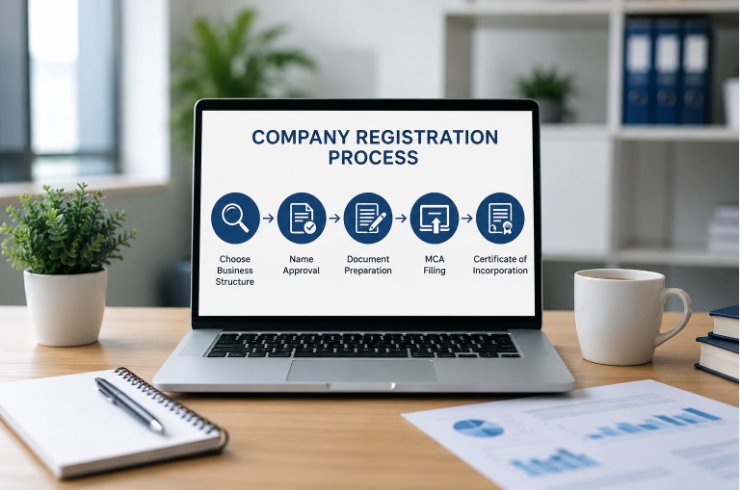
New Company Registration Process: Step-by-Step
The new company registration process involves several stages. Preparing the information and documents in advance can reduce unnecessary delays.
Step 1: Decide the Business Structure
The first step is deciding what type of entity is appropriate for your business.
Consider factors such as:
- Number of founders
- Ownership arrangement
- Investment requirements
- Business activity
- Liability protection
- Compliance requirements
- Future funding plans
- Expected business growth
For example, two founders planning to build a scalable startup may consider a Private Limited Company, while a solo entrepreneur may evaluate an OPC or another suitable structure.
Step 2: Choose a Suitable Company Name
Choosing a company name is an important part of incorporation.
The proposed name should generally:
- Be distinctive
- Not create confusion with an existing company or LLP
- Comply with applicable naming rules
- Not improperly use restricted or regulated words
- Reflect the proposed business activity where appropriate
It is advisable to conduct an MCA name search and consider trademark availability before finalising a name.
A company name being available on the MCA portal does not necessarily mean that the corresponding trademark is available. Therefore, checking both can help reduce future branding problems.
Step 3: Obtain Digital Signature Certificates
Company incorporation is completed electronically, so the relevant individuals need Digital Signature Certificates (DSCs) for signing electronic forms and documents.
Depending on the structure and circumstances, proposed directors or other authorised persons may need valid DSCs.
This is an early step that should be completed before submitting incorporation documentation.
Step 4: Obtain Director Identification Number
A Director Identification Number (DIN) is required for individuals who act as directors of a company.
For new incorporations, DIN-related requirements are handled through the applicable MCA incorporation process rather than always requiring a separate standalone application.
The applicant’s identity and address details must be provided accurately.
Step 5: Prepare Incorporation Documents
Document preparation is one of the most important parts of the registration process.
Typical documents may include:
- PAN card of proposed directors/subscribers
- Identity proof
- Address proof
- Recent photographs
- Residential address details
- Registered office proof
- Utility bill, where applicable
- Owner’s NOC for the registered office
- Rent or lease agreement, where applicable
- Digital signatures
- Details of directors and subscribers
Additional documents may be required depending on the applicant, registered office arrangement, foreign participation, or nature of the business.
Tip: Names and addresses should be consistent across documents. Small differences in spelling or address formatting can result in clarification requests.
Step 6: File the Incorporation Application
The incorporation application is submitted electronically through the MCA’s prescribed system and forms.
Depending on the type of entity, the application can cover matters such as:
- Company incorporation
- Name reservation
- Director details
- Registered office information
- Memorandum of Association
- Articles of Association
- PAN and TAN-related registrations
- Other linked registrations, where applicable
For companies, the SPICe+ incorporation framework is an important part of the MCA registration process.
The applicant should carefully review all information before submitting the application because errors can lead to resubmission or additional processing.
Step 7: Preparation of MOA and AOA
The Memorandum of Association (MOA) and Articles of Association (AOA) form an important part of company incorporation.
The MOA generally defines the company’s fundamental scope and objectives.
The AOA contains rules and regulations governing the company’s internal management.
For example, if a company intends to provide digital marketing services, its business objects should appropriately cover the proposed activities.
A well-drafted constitutional document can help avoid unnecessary amendments later.
Step 8: Government Review and Clarification
After submission, the MCA reviews the incorporation application and supporting documents.
If everything is in order, the application can proceed towards approval.
If the Registrar identifies an issue, clarification or resubmission may be required.
Common reasons for delays include:
- Incorrect information
- Inconsistent documents
- Address-related issues
- Name objections
- Incomplete attachments
- Incorrect signatures
- Issues with registered office documentation
This is why document verification before submission is an important part of the new company registration process.
Step 9: Receive the Certificate of Incorporation
Once the application is approved, the company receives its Certificate of Incorporation.
The certificate generally contains important details such as:
- Company name
- CIN
- Date of incorporation
- Registrar jurisdiction
- Legal status of the company
At this point, the company has been legally incorporated.
The incorporation process does not, however, mean that all post-incorporation compliance requirements have been completed.
Documents Required for New Company Registration
The exact documentation depends on the entity and circumstances, but the following checklist is commonly relevant for Indian promoters.
For Indian Directors or Subscribers
Common documents include:
- PAN card
- Identity proof
- Address proof
- Photograph
- Residential address details
- Digital Signature Certificate
- Registered office proof
- NOC from property owner, where applicable
For the Registered Office
Depending on the situation, documents may include:
- Ownership proof or relevant property document
- Rent or lease agreement
- Recent utility bill
- No-objection certificate from the owner
The registered office documentation should comply with the applicable MCA requirements.
Documents for Foreign Nationals or NRIs
Additional documentation and authentication requirements may apply where a proposed director or shareholder is located outside India.
Such cases may require notarisation, apostille, consular attestation, or other prescribed formalities depending on the country and circumstances.
How Much Does New Company Registration Cost?
The total cost of new company registration depends on several factors.
It can include:
- Government filing fees
- Stamp duty
- DSC charges
- Professional fees
- Name reservation charges, where applicable
- Additional documentation costs
- Registered office expenses, if applicable
Stamp duty and government charges can vary depending on the state, authorised capital, and structure of the entity.
Therefore, it is better to obtain a current cost estimate based on the proposed company structure, state, capital and number of subscribers rather than relying on a single fixed price.
How Long Does the New Company Registration Process Take?
The incorporation timeline depends on the accuracy of documents, name availability, government processing, and whether any clarification is raised.
If the documentation is complete and there are no objections or resubmission requirements, incorporation can often be completed within a relatively short period.
However, applicants should avoid assuming that every company will receive approval within the same number of days.
A practical approach is to:
- Finalise the structure.
- Check the proposed name.
- Prepare all documents.
- Obtain DSCs.
- Complete the incorporation forms carefully.
- Respond promptly if clarification is requested.
What Happens After Company Incorporation?
Receiving the Certificate of Incorporation is only the beginning of the company’s compliance journey.
Depending on the company and its activities, post-incorporation steps can include:
Open a Current Bank Account
The company normally needs a bank account for business transactions.
Banks may request incorporation documents, PAN, company constitutional documents, board resolutions, KYC documents and other information.
Deposit Subscription Money
Where applicable, subscribers should bring in the agreed subscription amount and comply with the applicable requirements.
File Applicable Commencement Declaration
Eligible companies may need to comply with the commencement of business requirements under the Companies Act.
The exact applicability should be checked based on the company’s circumstances and current law.
Maintain Books of Account
The company should maintain proper accounting records from the beginning.
Good bookkeeping makes GST, income tax, audit and ROC compliance significantly easier.
Complete Annual ROC Compliance
Companies generally have ongoing filing obligations with the MCA.
These can include annual financial statement and annual return filings, along with other event-based or director-related compliance as applicable.
Internal linking opportunity: Link “ROC Annual Compliance” to your detailed compliance service page.
Register for GST Where Applicable
GST registration may be required depending on turnover, nature of business, state, supplies and other applicable conditions.
Some businesses may also require GST registration for reasons other than crossing the general turnover threshold.
Obtain Business-Specific Licences
Depending on the nature of the business, additional registrations or licences may be necessary.
Examples include:
- FSSAI registration or licence
- Import Export Code
- Professional Tax registration
- Shops and Establishments registration
- MSME/Udyam registration
- Trademark registration
- EPF/ESI registrations
- Sector-specific licences
The requirement should be evaluated based on the actual business activity and location.
Common Mistakes to Avoid During Company Registration
Many incorporation problems can be prevented with proper preparation.
Choosing a Name Without Checking Trademarks
A name may appear available for company incorporation but still conflict with an existing trademark.
Always consider both corporate name availability and intellectual property concerns.
Providing Mismatched Documents
If the applicant’s name or address differs significantly between documents, the application may require clarification.
Check every document before submission.
Using an Inappropriate Registered Office Address
The registered office is an important legal address for the company.
Make sure the premises can be appropriately used as the registered office and that supporting documentation is available.
Selecting the Wrong Business Structure
Not every business should automatically register as a Private Limited Company Registration.
Consider ownership, liability, funding, compliance and long-term objectives before making the decision.
Ignoring Post-Incorporation Compliance
Incorporation does not end the compliance responsibility.
A newly incorporated company should immediately understand its accounting, tax, ROC and other applicable obligations.
New Company Registration vs LLP Registration vs OPC
The following comparison provides a simple starting point:
| Feature | Private Limited Company | LLP | OPC |
|---|---|---|---|
| Separate legal identity | Yes | Yes | Yes |
| Minimum members | Generally 2 | Generally 2 partners | 1 member |
| Limited liability | Yes | Yes | Yes |
| Suitable for investors | Generally suitable | More limited | More limited |
| Compliance level | Higher | Moderate | Moderate |
| Suitable for solo founder | No | No | Yes |
| Ownership through shares | Yes | No | Yes |
The right choice depends on the business rather than simply choosing the structure with the lowest registration cost.
Frequently Asked Questions
How do I start the new company registration process?
Start by selecting the appropriate business structure, choosing a suitable name, arranging DSCs and preparing the required identity, address and registered office documents. The incorporation application is then submitted through the MCA’s prescribed online process.
How many days does company registration take?
There is no universal fixed timeline. Processing depends on document accuracy, name approval, MCA processing and whether any clarification or resubmission is required. Complete documentation generally helps avoid unnecessary delays.
Is a Private Limited Company better than an LLP?
Neither structure is universally better. A Private Limited Company may be preferable for businesses seeking equity investment and a conventional corporate structure, while an LLP can provide greater operational flexibility for suitable businesses and professional ventures.
Can one person register a company in India?
Yes. An eligible individual can consider One Person Company registration, subject to the applicable legal requirements. Other business structures may also be available depending on the person’s circumstances.
What documents are required for company registration?
Common documents include PAN, identity proof, address proof, photographs, DSCs and registered office documents. Additional documents may be required depending on the promoters, ownership structure and business circumstances.
Conclusion
The new company registration process becomes much easier when the business structure, name, documents and incorporation details are prepared correctly from the beginning. A Private Limited Company, LLP and OPC each serve different business needs, so the right structure should be selected based on ownership, liability, funding plans and compliance requirements.
After incorporation, entrepreneurs should also pay attention to GST, accounting, tax filings, ROC compliance and industry-specific registrations. Treating compliance as part of the business setup not as an afterthought can help create a stronger foundation for long-term growth.
If you are planning new company registration and need assistance with choosing the appropriate structure, preparing documents, filing the incorporation application or handling post-registration compliance, professional support can make the process more organised.
Planning to start your business? Contact Company Registration Consultancy for assistance with company incorporation and related registrations.