
Introduction
Starting a non-governmental organization (NGO) or a charitable trust in India is a noble endeavor. However, running it successfully requires more than just good intentions; it demands financial sustainability and legal credibility. The most effective way to achieve both is by obtaining 12A 80G registration. Without 12A and 80G registration, your NGO may struggle to attract donors and could face tax liabilities on its surplus income. These registrations not only provide valuable tax benefits but also enhance your organization’s credibility, making it easier to secure donations, grants, and CSR funding opportunities
Navigating the Income Tax Department’s requirements can be daunting. This is where professional 12A & 80G registration services become invaluable. In this comprehensive guide, we will explain everything you need to know from eligibility and documentation to fees and post-compliance. Whether you are setting up a new trust or managing an existing society, understanding the nuances of 12a and 80g registration will determine your organization’s long-term success.
Get Expert 12A & 80G Registration Assistance
Need help with 12A 80G registration for your NGO, Trust, or Society? Our experts handle documentation, application filing, and compliance support to ensure a smooth registration process.
Documentation Support
Online Application Filing
Expert Guidance
Fast Process
Call Now for More information
What is 12A Registration?
12A registration is a certification issued under Section 12A of the Income Tax Act, 1961. It grants a charitable trust or NGO exemption from paying income tax on its surplus income. Normally, any entity earning an income is liable to pay tax. However, if your NGO holds a valid 12A registration, the Income Tax Department recognizes that your income is being utilized for charitable or religious purposes, not for profit generation.
In simple terms, 12a 80g registration starts with 12A. Without 12A, your NGO’s entire surplus could be taxed at the normal slab rates (up to 30%). Once you secure this registration, you can claim that your income is exempt, provided you maintain proper books of accounts and utilize the funds for your stated objectives.
What is 80G Registration?
While 12A protects the NGO from tax, 80G registration protects the donors. Under Section 80G of the Income Tax Act, donors who contribute to your NGO can claim a deduction on their taxable income. For example, if a business donates ₹1,00,000 to an NGO with valid 80G status, they can deduct 50% of that amount from their taxable income, effectively reducing their tax bill.
Thus, 12a and 80g registration work as a twin-engine system. One ensures the NGO Darpan survives without tax burdens, and the other incentivizes the public to fund your cause. Most informed donors today specifically ask, “Do you have 80G?” before writing a cheque. Without it, fundraising becomes exponentially harder.
Why NGOs and Trusts Need 12A & 80G Registration
Many new NGO founders ask: Is it mandatory? Technically, no. But practically, yes. Here is why every serious NGO must pursue 12a 80g registration:
- Legal Tax Exemption: Without 12A, the Income Tax Department will treat your donations as income. You could end up paying 30% tax on the very funds meant for social work.
- Donor Confidence: 80G registration provides a tax receipt to donors. Individuals and corporations prefer giving to registered 80G entities because it reduces their own tax liability.
- Government Grants: Most government funding schemes (like NITI Aayog’s Darpan) require valid 12a and 80g registration before releasing grants.
- Bank Account & FCRA: Many banks ask for these registrations to open current accounts. Foreign Contribution Regulation Act (FCRA) registration also requires existing 12A and 80G.
- Audit Requirements: Registered entities must undergo mandatory audits, which improves financial transparency and credibility.
In short, skipping 12a and 80g registration means your NGO will operate like an unregistered business, not a charitable institution.
Key Benefits of 12A & 80G Registration
Let us break down the specific advantages into two categories: benefits for the NGO and benefits for the donor.
Tax Exemption Benefits for NGOs
Once you complete your 12a and 80g registration, your NGO enjoys the following tax exemptions:
- Exemption on surplus income: Any income derived from property held under trust (donations, grants, corpus funds) is fully exempt from tax.
- Carry forward of losses: Even if you incur a loss, you can carry it forward without paying minimum alternate tax (MAT) in many cases.
- No TDS on certain receipts: In some cases, donors are not required to deduct TDS if you provide a valid 12A certificate.
- Lower scrutiny risk: Registered NGOs face fewer random tax notices compared to unregistered entities.
Tax Benefits for Donors under 80G
When you obtain 80G as part of your 12a 80g registration, donors receive:
- 50% Deduction without limit: Most NGOs fall under the 50% category. A donor can deduct 50% of the donation amount from their gross total income.
- Eligibility for both individuals and businesses: Salaried employees, Hindu Undivided Families (HUFs), companies, and firms can all claim 80G benefits.
- No upper ceiling on donation amount: Unlike some other sections, 80G does not cap the donation amount (though deduction is limited to 50%).
- Qualified donation for CSR: Corporate Social Responsibility (CSR) spending requires the recipient NGO to have 12A and 80G.
Practical Example: Mr. Sharma earns ₹12,00,000 per year. He donates ₹1,00,000 to an NGO with 80G. His taxable income becomes ₹12,00,000 – ₹50,000 (50% of donation) = ₹11,50,000. He saves tax of approximately ₹15,000 (depending on his slab).
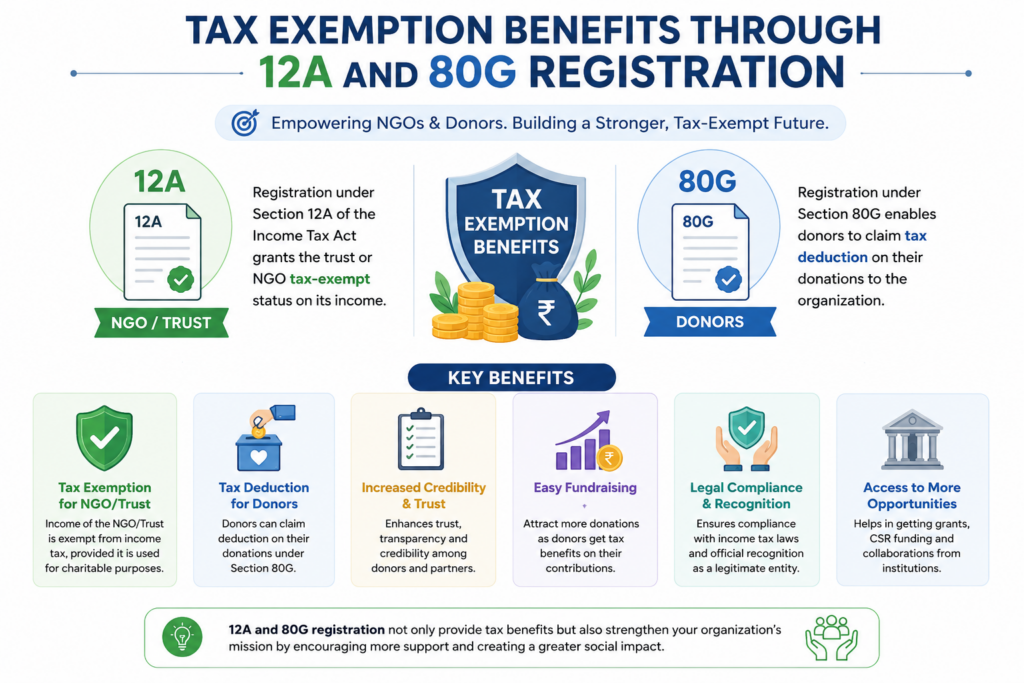
Tax Exemption Benefits of 12A & 80G Registration
12A and 80G registration offer valuable tax benefits for charitable organizations and their donors. These registrations help NGOs gain tax exemptions, improve credibility, and attract more donations for social welfare activities.
✔ Income Tax Exemption for NGOs
✔ Tax Deduction Benefits for Donors
✔ Increased Trust and Credibility
✔ Better Fundraising Opportunities
✔ Legal Compliance and Recognition
Call Now for More information
Eligibility Criteria
Not every trust or NGO qualifies automatically. To apply for 12a and 80g registration, your organization must meet these conditions:
- Legal Entity: You must be registered as a Trust, Society, or Section 8 Company.
- Registered Deed: The trust deed or memorandum of association must clearly state charitable objectives.
- No Profit Motive: The primary objective cannot be profit generation. Commercial activities are allowed only if incidental to charity.
- Operational Status: You need at least one year of operational history (for 80G, often less if provisional registration is sought after 2020 amendments).
- Registration under old vs new regime: Post-2020, the Income Tax Department introduced new Sections 12AB and 80G(5)(vi). Existing NGOs must re-register.
Note that provisional 12a and 80g registration is available for newly registered NGOs for three years, after which you must apply for regular registration.
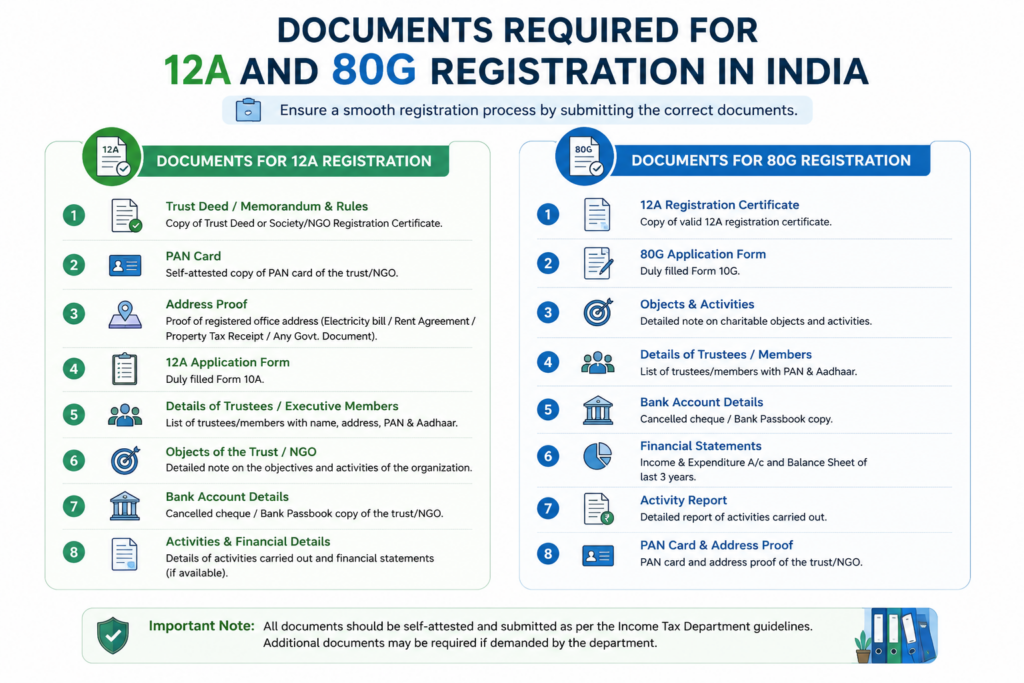
Documents Required
Before hiring any 12A & 80G registration services, gather the following documents. Missing paperwork is the number one cause of application rejection.
Essential Document Checklist
- Registration Certificate: Trust registration, Society registration, or Certificate of Incorporation (for Section 8).
- Trust Deed / MOA & AOA: Duly notarized and certified copy.
- PAN Card of the NGO: Mandatory for filing income tax forms.
- Address Proof: Electricity bill, rent agreement, or property tax receipt of the registered office.
- List of Trustees/Members: Names, addresses, and PAN copies of all board members.
- Bank Account Statement: First page of passbook or a cancelled cheque.
- Audited Financial Statements: For the last three years (for existing NGOs). For new NGOs, a projected income-expenditure statement.
- Form 10A / Form 10AB: The application forms for registration.
- Self-certified copies of donation receipts (if any): To prove charitable activity.
Step-by-Step Registration Process
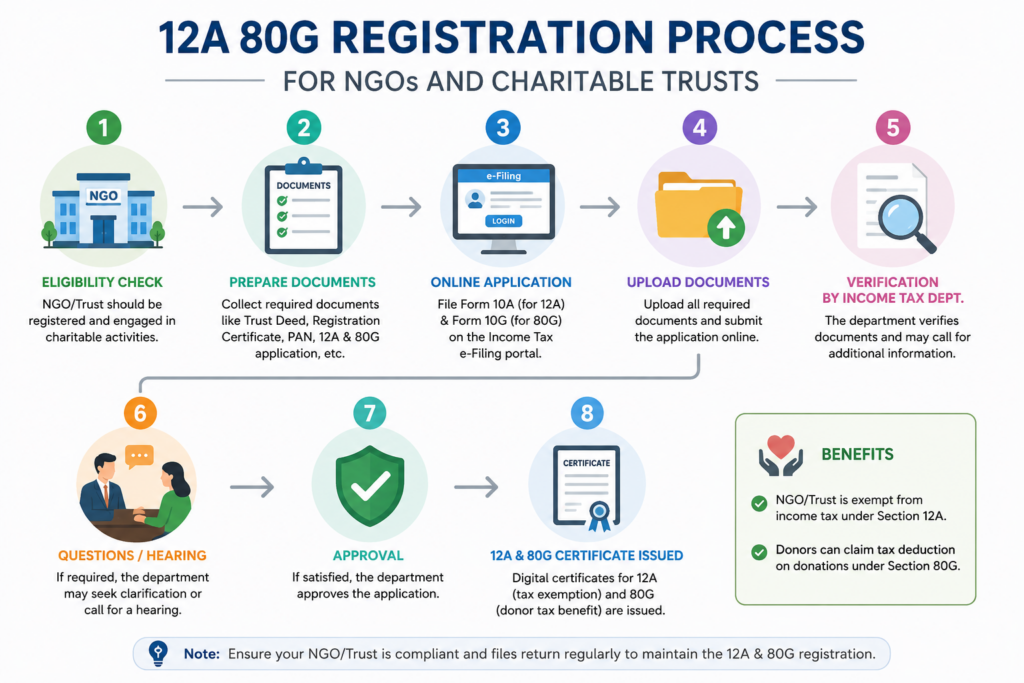
Here is the exact workflow for obtaining 12a and 80g registration today. The process is entirely online via the Income Tax Portal.
Step 1: Obtain Digital Signature Certificate (DSC)
The application must be digitally signed by a trustee or authorized signatory. Class 2 or Class 3 DSC is required.
Step 2: Register on the Income Tax e-Filing Portal
Your NGO needs a valid user ID on the portal. If you already have a PAN, register as a “Trust” or “Entity.”
Step 3: Prepare Form 10A or Form 10AB
- Form 10A is for new NGOs seeking provisional registration.
- Form 10AB is for existing NGOs (registered before April 1, 2021) seeking re-registration or regular registration after the provisional period.
Step 4: Upload Documents and Submit
Upload all the documents listed above. Double-check that the trust deed includes all amendments.
Step 5: Pay the Application Fee
There is a nominal fee based on your total income. Your 12a and 80g registration fees will be calculated automatically on the portal.
Step 6: Wait for Commissioner (Exemption) Approval
The Jurisdictional Commissioner of Income Tax (Exemptions) reviews your application. They may call for additional details or ask for a virtual hearing.
Step 7: Receive Registration Order
Upon approval, you will receive an order under Section 12AB and Section 80G(5)(vi). This order contains your unique registration number and validity period.
Timeline: Typically 15 to 45 working days, provided all documents are in order.
12A and 80G Registration Fees Explained
One of the most common questions is about the 12a and 80g registration fees. Let us clarify this thoroughly. The fee structure is governed by the Income Tax Rules.
Official Government Fees
As per the current rules, the application fee for 12a and 80g registration depends on the total income of the NGO:
| Total Income of NGO (Previous Year) | Government Fee (₹) |
| Nil or up to ₹1,00,000 | ₹500 |
| ₹1,00,001 to ₹10,00,000 | ₹1,000 |
| ₹10,00,001 to ₹50,00,000 | ₹2,500 |
| Above ₹50,00,000 | ₹5,000 |
These 12a and 80g registration fees are paid online via net banking, credit card, or NEFT on the e-filing portal.
Professional Service Charges
While the government fee is low, the complexity of drafting the trust deed, compiling the audit report, and filing the forms requires expert help. Professional 12A & 80G registration services typically charge between ₹15,000 to ₹40,000 depending on the city and the NGO’s complexity. This includes:
- Document review and rectification.
- Drafting of resolution and affidavits.
- Filing of Form 10A/10AB.
- Representation before the tax officer.
- Post-registration compliance guidance.
Warning: Be wary of agents quoting extremely low fees. Incomplete applications often lead to rejection, and you will have to pay the 12a and 80g registration fees again for a fresh application.
Common Mistakes to Avoid
Even experienced trust members make these errors. Avoiding them can save you months of delay.
- Using an Old Trust Deed: If your trust deed lacks “charitable purpose” wording or includes a clause allowing profit distribution to trustees, your application will be rejected.
- Mismatched Financials: The IT department cross-verifies bank statements with Form 10A. Any unexplained deposits or personal expenses claimed as charitable will lead to scrutiny.
- Missing Online Signatures: Physical signatures are not accepted. Ensure your DSC is valid and properly linked.
- Applying for 80G before 12A: You cannot get 80G without first obtaining or simultaneously applying for 12A. They are processed together but require separate eligibility.
- Ignoring the Re-registration Deadline: NGOs registered before April 1, 2021 had to re-apply by March 31, 2022. If you missed it, you are now unregistered. Seek immediate professional help.
Compliance Requirements After Registration
Obtaining 12a and 80g registration is not the end; it is the beginning of ongoing compliance. Failure to comply can lead to cancellation of registration.
Annual Compliance Checklist
- File Income Tax Return (ITR-7): Must be filed every year by October 31. Even if there is no tax liability, filing is mandatory.
- Get Accounts Audited (Form 10B or 10BB): If your total income exceeds ₹2.5 crore (or ₹5 crore in certain cases), you need a tax audit.
- Maintain Donor Register: Keep records of all donations exceeding ₹50,000, including donor PAN.
- Utilization of Funds: At least 85% of the income must be applied towards charitable activities. Any shortfall must be carried forward.
- No Private Benefit: Ensure no trustee or relative receives unreasonable compensation from the trust.
If you fail to file returns for three consecutive years, the IT department can withdraw your 12a and 80g registration retroactively.
Renewal and Validity Rules
The rules changed significantly after the Finance Act 2020.
- Provisional Registration (New NGOs): Valid for 3 years. After that, you must apply for regular registration using Form 10AB.
- Regular Registration (Old NGOs): Previously, it was perpetual. Now, regular registration is valid for 5 years. You must apply for renewal every 5 years.
- Automatic Expiry: If you do not apply for renewal at least 6 months before expiry, the registration lapses. You will lose tax exemption and 80G benefits until renewed.
This is why ongoing 12A & 80G registration services are crucial. A professional firm will track your expiry date and file the renewal on time.
How Professional Registration Services Help
You might wonder, “Can I do this myself?” Technically, yes. But the risk of rejection is high. Professional 12a and 80g registration service providers offer:
- Document Audit: They review your trust deed line-by-line to ensure it meets judicial precedents.
- Representation: If the Commissioner issues a notice (e.g., “Explain why your expenditure is not speculative”), a professional drafts the legal response.
- Speed: Professionals have practice before specific jurisdictional commissioners. They know which officers require additional annexures.
- Post-Registration Support: They file your ITR-7, prepare Form 10B, and send reminders for renewal.
- Fee Optimization: They correctly calculate your 12a and 80g registration fees to avoid overpayment or underpayment errors.
For example, a service firm can identify if your NGO qualifies for provisional registration (lower compliance burden) versus regular registration. They also help merge the application for both 12A and 80G into a single process, saving you time and duplicate 12a and 80g registration fees.
FAQs
Yes. Both registrations can be applied for together through Form 10A or 10AB.
Government fees are minimal, while professional charges vary depending on the consultant and scope of work.
No. 80G registration is generally valid for 5 years and requires renewal.
Yes. Section 8 Companies are fully eligible for both registrations.
Usually 7 to 10 months, depending on document verification and department processing.
Conclusion
Securing 12A & 80G registration is the single most important financial decision for your NGO or trust. It transforms your organization from an unregistered entity into a tax-efficient, donor-friendly, government-recognized charitable institution. Without it, you are leaving money on the table both in terms of tax savings and lost donations.
While the process is now online, the legal complexities of the Income Tax Act make self-filing risky. A single error in your trust deed’s wording or a mismatch in your audit report can lead to rejection and the loss of precious time.
Do not let paperwork hold back your social mission. Professional 12a and 80g registration services ensure that your application is flawless the first time, your 12a and 80g registration fees are correctly paid, and your compliance remains intact for years.