
FSSAI License Registration Online in India | Food License
Apply for FSSAI License online with expert assistance. Fast registration, renewal, and complete food business compliance.
Our Client












If you are planning to start a food business in India, obtaining an FSSAI License is one of the most important legal requirements. Whether you manufacture, process, package, store, distribute, transport, import, export, or sell food products, this approval helps ensure that your business complies with the food safety standards prescribed by the Government of India.
The Food Safety and Standards Authority of India (FSSAI) regulates the food industry to ensure that food products available to consumers are safe, hygienic, and of good quality. An FSSAI License not only helps businesses meet legal requirements but also builds customer trust and enhances brand credibility.
From small home-based food businesses to restaurants, hotels, cloud kitchens, food manufacturers, wholesalers, retailers, importers, exporters, and large food processing companies, every eligible Food Business Operator (FBO) should obtain the appropriate food licence based on the nature and scale of operations.
Whether you have recently completed a New Company Registration or are already running an existing business, obtaining the required food business licence is an essential step before commencing food-related activities. Businesses may also consider MSME Registration to access government schemes and Trade Mark Registration to protect their brand identity.
This comprehensive guide explains everything about FSSAI License, including eligibility, types of licences, required documents, registration process, benefits, validity, renewal, and frequently asked questions.
What is an FSSAI License?
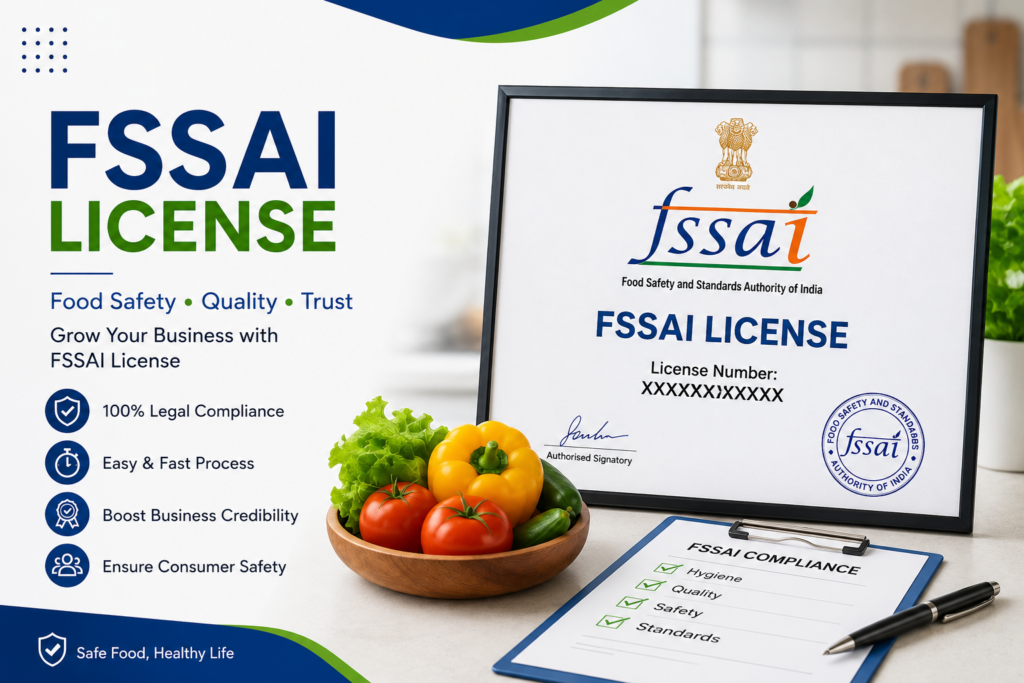
An FSSAI License is a legal authorization issued by the Food Safety and Standards Authority of India (FSSAI) under the Food Safety and Standards Act, 2006. It allows eligible Food Business Operators (FBOs) to manufacture, process, store, distribute, transport, import, export, or sell food products while complying with prescribed food safety standards.
After approval, the business receives a unique 14-digit FSSAI Licence Number, which must be displayed on food packages and at the business premises wherever applicable.
The primary objective is to:
- Ensure food safety
- Maintain food quality standards
- Protect consumer health
- Regulate food businesses
- Promote hygienic food practices
- Improve transparency in the food industry
This certification demonstrates that a business follows the required food safety regulations and quality standards.
Why is an FSSAI License Important?
Obtaining this licence provides both legal and commercial benefits for food businesses.
Some major advantages include:
- Legal compliance
- Consumer confidence
- Better business reputation
- Improved food safety
- Easier business expansion
- Increased market credibility
- Eligibility for food supply contracts
- Improved brand image
A valid food licence also helps businesses build long-term customer trust while ensuring compliance with applicable regulations.
Who Needs an FSSAI License?
Any business involved in food-related activities may require an FSSAI License depending on the nature and scale of operations.
Common Food Business Operators include:
Food Manufacturers
Businesses manufacturing packaged or processed food products.
Restaurants
Restaurants serving prepared food to customers.
Cloud Kitchens
Online food delivery businesses operating without dine-in facilities.
Hotels
Hotels offering food and beverage services.
Food Retailers
Shops selling packaged or fresh food products.
Food Wholesalers
Businesses supplying food products in bulk.
Food Distributors
Businesses distributing food products across different markets.
Food Storage Units
Cold storage facilities and warehouses storing food products.
Caterers
Businesses provide catering services for events and functions.
Food Importers
Businesses importing food products into India.
Food Exporters
Businesses exporting food products to international markets. Such businesses should also obtain an Export Import Code to comply with import-export regulations.
Dairy Businesses
Milk processing units and dairy product manufacturers.
Bakery Businesses
Bakeries produce bread, cakes, pastries, biscuits, and other baked products.
Meat and Poultry Businesses
Businesses dealing with meat, poultry, seafood, and related products.
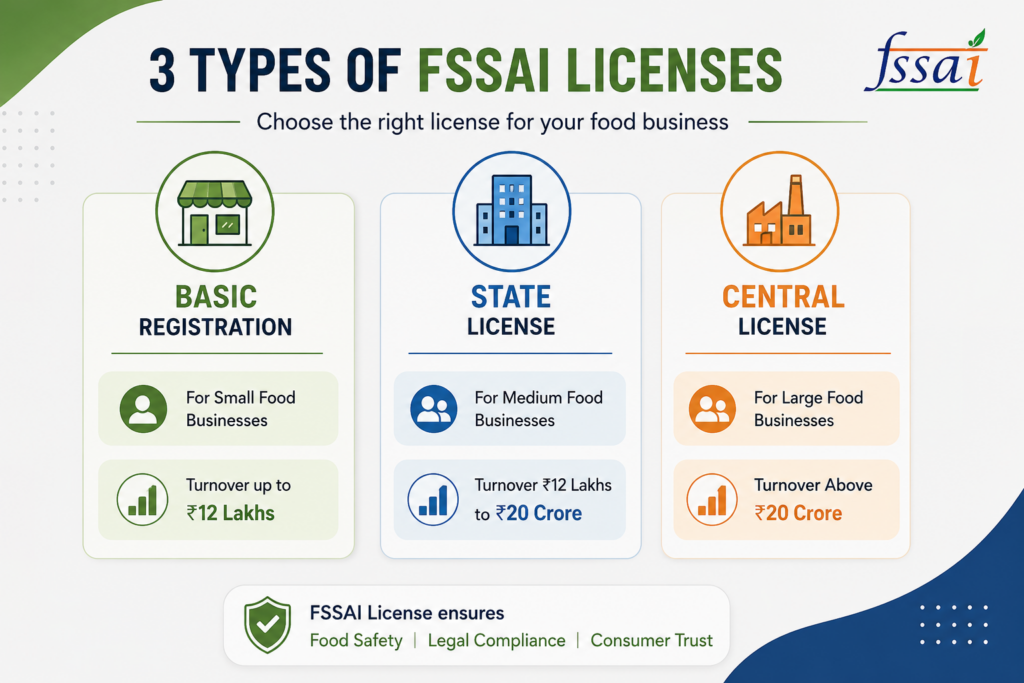
Types of FSSAI License
The type of licence depends on the size, turnover, and nature of the food business.
Basic FSSAI Registration
Basic Registration is generally suitable for small food businesses that fall within the prescribed eligibility limits.
It is commonly applicable to:
- Small retailers
- Home-based food businesses
- Petty food manufacturers
- Street food vendors
- Small distributors
State FSSAI License
A State Licence is generally required for medium-sized food businesses operating within a particular state.
Examples include:
- Restaurants
- Mid-sized manufacturers
- Storage units
- Transporters
- Food processors
- Medium-scale wholesalers
Central FSSAI License
A Central Licence is generally required for larger food businesses or businesses involved in interstate operations, import, export, or food manufacturing on a larger scale.
It is commonly applicable to:
- Large manufacturers
- Food importers
- Food exporters
- Large retail chains
- Airport food operators
- Seaport businesses
- Central Government establishments
Eligibility for FSSAI License
Eligibility depends upon several factors, including:
- Nature of business
- Annual turnover
- Business size
- Production capacity
- Location of business
- Type of food activity
Applicants should determine the appropriate licence category before applying.
Benefits of FSSAI License
Obtaining the required food licence offers numerous advantages.
Legal Recognition
Ensures compliance with food safety regulations.
Consumer Trust
Customers prefer businesses with valid food safety certification.
Brand Reputation
Enhances credibility and business image.
Better Business Opportunities
Many distributors and retailers prefer dealing with licensed food businesses.
Easier Business Expansion
Supports expansion into new markets and online food platforms.
Regulatory Compliance
Helps businesses comply with food safety laws.
Improved Food Quality
Encourages better hygiene and food handling practices.
Why Choose Professional FSSAI License Services?
Although the application process is online, professional guidance helps avoid mistakes and unnecessary delays.
Professional assistance includes:
- Eligibility assessment
- Licence category selection
- Document verification
- Online application filing
- Application tracking
- Renewal assistance
- Compliance guidance
As your business grows, you may also require Digital Signature Certificate, ISO Certification, ESI Registration, EPF Registration, or MSME Registration to strengthen legal compliance and business credibility. Charitable food organizations may also require Trust Registration and NGO Darpan Registration, while businesses seeking brand protection should consider Trade Mark Registration.
Documents Required for FSSAI License
Submitting the correct documents is one of the most important steps in obtaining an FSSAI License. Proper documentation helps ensure faster verification and minimizes the chances of application rejection or delays. The required documents may vary depending on the type of licence and the nature of the food business.
The following documents are generally required while applying.
1. Identity Proof
The identity proof of the proprietor, partner, director, or authorised signatory is generally required.
Accepted identity proofs may include:
- Aadhaar Card
- PAN Card
- Passport
- Voter ID
- Driving Licence
2. Address Proof
Applicants should provide valid business address proof.
Common address proof documents include:
- Electricity Bill
- Rent Agreement
- Property Tax Receipt
- Water Bill
- Sale Deed
- Utility Bill
3. Passport Size Photograph
Recent passport-size photographs of the applicant or authorised signatory may be required.
4. PAN Card
PAN details of the business or applicant are generally required for verification.
5. Business Constitution Documents
Depending on the constitution of the business, applicants may provide:
- Proprietorship Details
- Partnership Deed
- Certificate of Incorporation
- LLP Agreement
- Trust Deed
- Society Registration Certificate
Businesses planning to establish a new legal entity should first complete New Company Registration before applying for the appropriate food business licence.
6. Business Registration Details
Where applicable, applicants should provide details relating to:
- GST Registration
- MSME Registration
- Trade License
- Shop & Establishment Registration
Businesses can also benefit from MSME Registration, which provides access to various government schemes and financial assistance.
7. Food Business Details
Applicants should keep details regarding:
- Nature of food business
- Food category
- Manufacturing activities
- Storage capacity
- Distribution activities
- Transportation facilities
8. Import Export Details (If Applicable)
Businesses involved in importing or exporting food products should obtain an Export Import Code in addition to the appropriate licence.
Information Required for FSSAI License
Before beginning the application process, applicants should keep the following information ready:
- Applicant Name
- Business Name
- Mobile Number
- Email Address
- Business Address
- Type of Business
- Food Category
- Nature of Business Activity
- Production Capacity (where applicable)
- Turnover Details
- Number of Employees
- PAN Details
- Aadhaar Details
- Bank Details
Preparing this information in advance helps complete the application smoothly and reduces the possibility of delays.
Step-by-Step FSSAI License Registration Process
Obtaining an FSSAI License involves a systematic application process.
Step 1 – Determine the Appropriate Licence
The first step is identifying whether your business requires:
- Basic Registration
- State Licence
- Central Licence
The applicable category depends on turnover, business activities, and the scale of operations.
Step 2 – Collect Required Documents
Gather all necessary documents before starting the application.
Proper documentation helps reduce delays during verification.
Step 3 – Prepare the Application
Fill in the required business information carefully, including:
- Applicant details
- Business information
- Food business activity
- Address details
- Contact information
- Business constitution
- Food category
Ensure all information is accurate before submission to avoid unnecessary queries.
Step 4 – Upload Supporting Documents
Upload all applicable documents in the prescribed format.
Clear and accurate documentation helps speed up the approval process.
Step 5 – Submit the Application
After verifying all the information, submit the online application through the prescribed portal.
Step 6 – Verification by Authorities
The concerned authority reviews the submitted application and supporting documents.
Where applicable, additional clarification or inspection may also be conducted before approval.
Step 7 – Issue of FSSAI License
Upon successful verification, the applicant receives the licence along with a unique 14-digit licence number.
The business can then legally operate in accordance with the applicable food safety regulations.
Government Fees for FSSAI License
The government fee depends on several factors, such as:
- Type of Licence
- Nature of Business
- Business Size
- Production Capacity
- Annual Turnover
- Licence Validity Period
Applicants should always verify the latest fee structure before submitting the application.
Professional consultancy charges may also apply if expert assistance is taken for documentation and application filing.
Time Required for FSSAI License
The processing time depends upon:
- Type of licence
- Accuracy of documents
- Verification process
- Business category
- Inspection requirements (where applicable)
Applications submitted with complete and accurate documentation are generally processed more efficiently.
Validity of FSSAI License
The licence is issued for a selected validity period as permitted under the applicable regulations.
Businesses should ensure timely renewal before expiry to avoid compliance issues and interruptions in business operations.
Renewal of FSSAI License
Timely renewal is essential to continue operating legally.
The renewal process generally involves:
- Verifying business details
- Updating required information
- Submitting the renewal application
- Paying the applicable fee
- Completing any additional verification, if required
Applying for renewal before the expiry date helps avoid penalties and operational disruptions.
Features of FSSAI License
Obtaining this licence provides several operational and legal advantages.
Legal Authorization
Allows eligible food businesses to operate lawfully.
Food Safety Compliance
Ensures adherence to prescribed food safety standards.
Unique Licence Number
Every approved applicant receives a unique 14-digit licence number.
Improved Business Credibility
Builds confidence among customers, suppliers, and regulatory authorities.
Better Market Access
Many retailers, distributors, and online marketplaces prefer working with licensed food businesses.
Consumer Confidence
A valid licence reassures customers about food quality and safety.
SAI License
The type of FSSAI License depends on the size, turnover, and nature of the food business.
Basic FSSAI Registration
Basic Registration is generally suitable for small food businesses that fall within the prescribed eligibility limits.
It is commonly applicable to:
- Small retailers
- Home-based food businesses
- Petty food manufacturers
- Street food vendors
- Small distributors
State FSSAI License
A State FSSAI License is generally required for medium-sized food businesses operating within a particular state.
Examples include:
- Restaurants
- Mid-sized manufacturers
- Storage units
- Transporters
- Food processors
- Medium-scale wholesalers
Central FSSAI License
A Central FSSAI License is generally required for larger food businesses or businesses involved in interstate operations, import, export, or food manufacturing on a larger scale.
It is commonly applicable to:
- Large manufacturers
- Food importers
- Food exporters
- Large retail chains
- Airport food operators
- Seaport businesses
- Central Government establishments
Eligibility for FSSAI License
Eligibility for an FSSAI License depends upon factors such as:
- Nature of business
- Annual turnover
- Business size
- Production capacity
- Location of business
- Type of food activity
Applicants should determine the appropriate category before applying for an FSSAI License.
Benefits of FSSAI License
Obtaining an FSSAI License offers numerous advantages.
Legal Recognition
Ensures compliance with food safety regulations.
Consumer Trust
Customers prefer businesses with valid food safety certification.
Brand Reputation
Enhances credibility and business image.
Better Business Opportunities
Many distributors and retailers prefer dealing with licensed businesses.
Easier Business Expansion
Supports expansion into new markets and online food platforms.
Regulatory Compliance
Helps businesses comply with food safety laws.
Improved Food Quality
Encourages better hygiene and food handling practices.
Why Choose Professional FSSAI License Services?
Although the application process is online, professional guidance helps avoid mistakes and delays.
Professional assistance includes:
- Eligibility assessment
- License category selection
- Document verification
- Online application filing
- Application tracking
- Renewal assistance
- Compliance guidance
As your business grows, you may also require Digital Signature Certificate, ISO Certification, ESI Registration, EPF Registration, or MSME Registration to strengthen legal compliance and business credibility. Charitable food organizations may also require Trust Registration and NGO Darpan Registration, while businesses seeking brand protection should consider Trade Mark Registration.
Documents Required for FSSAI License
Submitting the correct documents is one of the most important steps in obtaining an FSSAI License. Proper documentation helps ensure faster verification and minimizes the chances of application rejection or delays. The documents required may vary depending on the type of FSSAI License and the nature of the food business.
The following documents are generally required while applying for an FSSAI License.
1. Identity Proof
The identity proof of the proprietor, partner, director, or authorized signatory is generally required.
Accepted identity proofs may include:
- Aadhaar Card
- PAN Card
- Passport
- Voter ID
- Driving Licence
2. Address Proof
Applicants should provide valid business address proof.
Common address proof documents include:
- Electricity Bill
- Rent Agreement
- Property Tax Receipt
- Water Bill
- Sale Deed
- Utility Bill
3. Passport Size Photograph
Recent passport-size photographs of the applicant or authorized signatory may be required.
4. PAN Card
PAN details of the business or applicant are generally required for verification.
5. Business Constitution Documents
Depending on the constitution of the business, applicants may provide:
- Proprietorship Details
- Partnership Deed
- Certificate of Incorporation
- LLP Agreement
- Trust Deed
- Society Registration Certificate
Businesses planning to establish a new legal entity should first complete New Company Registration before applying for the appropriate FSSAI License.
6. Business Registration Details
Where applicable, applicants should provide details relating to:
- GST Registration
- MSME Registration
- Trade License
- Shop & Establishment Registration
Businesses can also benefit from MSME Registration, which provides access to various government schemes and financial assistance.
7. Food Business Details
Applicants should keep details regarding:
- Nature of food business
- Food category
- Manufacturing activities
- Storage capacity
- Distribution activities
- Transportation facilities
8. Import Export Details (If Applicable)
Businesses involved in importing or exporting food products should obtain an Export Import Code in addition to the appropriate FSSAI License.
Common Reasons for FSSAI License Rejection
Applications may face delays or rejection due to:
- Incorrect applicant details
- Wrong licence category
- Incomplete documentation
- Incorrect business activity
- Invalid address proof
- Mismatch in PAN or Aadhaar details
- Inaccurate business information
- Improper document uploads
Professional assistance helps minimise these issues and significantly improves the chances of successful approval.
Additional Registrations That Complement FSSAI License
Along with an FSSAI License, many businesses require additional registrations to ensure complete legal compliance and support long-term growth.
Depending on your business activities, you may also require:
- Trade Mark Registration to protect your business name and logo.
- Digital Signature Certificate for secure online filings and statutory compliance.
- ISO Certification to improve quality standards and customer confidence.
- ESI Registration for eligible employers under the Employees’ State Insurance Act.
- EPF Registration to comply with employee provident fund requirements.
- Trust Registration for charitable organizations involved in food distribution or welfare activities.
- NGO Darpan Registration for NGOs seeking recognition and collaboration with government departments.
Obtaining these registrations alongside an FSSAI License strengthens compliance, improves business credibility, and supports sustainable business growth.
Benefits of FSSAI License
Obtaining an FSSAI License offers numerous legal, financial, and business advantages. Whether you operate a restaurant, cloud kitchen, food manufacturing unit, bakery, catering business, supermarket, dairy, food processing unit, or online food business, this certification helps establish credibility while ensuring compliance with food safety regulations.
Below are the major benefits of obtaining an FSSAI License.
1. Legal Compliance
An FSSAI License ensures that your food business complies with the Food Safety and Standards Act, 2006.
Operating with a valid licence helps businesses avoid legal complications, penalties, and regulatory issues.
2. Builds Customer Trust
Consumers are more likely to purchase food products from businesses displaying a valid food licence.
The unique licence number assures customers that food products are prepared, processed, and handled according to prescribed safety standards.
3. Enhances Brand Reputation
A valid licence strengthens the reputation of your business.
Customers, distributors, retailers, suppliers, and business partners generally prefer dealing with compliant food businesses.
4. Expands Business Opportunities
Businesses with proper licensing can expand more confidently into:
- Retail chains
- Supermarkets
- Online marketplaces
- Hotels
- Restaurants
- Government contracts
- Food delivery platforms
Regulatory compliance increases business credibility during expansion.
5. Improves Food Safety Standards
The objective of food licensing is to ensure proper food handling, storage, processing, manufacturing, packaging, and distribution.
Following these standards improves overall food quality and consumer safety.
6. Supports Business Growth
Businesses operating with proper approval often find it easier to build long-term customer relationships and attract new opportunities.
It also demonstrates the owner’s commitment to quality and regulatory compliance.
7. Better Market Recognition
Having a valid food licence differentiates your business from unregistered food operators.
It enhances your professional image and creates confidence among consumers.
8. Helps During Business Expansion
Whether you plan to open additional branches or expand into new states, having the appropriate approval supports legal business operations and facilitates smoother expansion.
Why FSSAI License is Important for Food Businesses
Every food business is responsible for maintaining food quality and protecting public health.
Obtaining an FSSAI License helps businesses:
- Follow food safety standards
- Maintain hygiene
- Improve customer confidence
- Build brand value
- Meet legal requirements
- Reduce compliance risks
- Improve product quality
- Support long-term business growth
For food businesses, an FSSAI License is not merely a legal requirement—it is an important business asset that enhances trust and credibility.
Penalties for Operating Without FSSAI License
Operating a food business without the required FSSAI License, where applicable, may lead to regulatory action under the Food Safety and Standards Act, 2006.
Depending on the nature and severity of the non-compliance, authorities may take actions such as:
- Monetary penalties
- Suspension of business operations
- Cancellation or refusal of licence
- Seizure of food products
- Legal proceedings
- Other actions as permitted under applicable law
To avoid unnecessary legal complications, eligible food businesses should obtain the appropriate licence before commencing operations.
Common Mistakes to Avoid While Applying
Although the application process is straightforward, applicants often make avoidable mistakes that may delay approval.
Selecting the Wrong Licence Category
Choosing the incorrect licence type may delay approval or require a fresh application.
Applicants should carefully determine whether they need:
- Basic Registration
- State Licence
- Central Licence
Providing Incorrect Business Information
Incorrect business details can delay the verification process.
Always verify:
- Business Name
- Address
- Business Activity
- Contact Details
- Organization Type
before submitting the application.
Uploading Incomplete Documents
Missing or unclear documents are among the most common reasons for application delays.
Applicants should ensure that all supporting documents are complete, updated, and clearly legible.
Incorrect Food Category
Selecting the wrong food business category may result in incorrect licensing.
Applicants should accurately describe their food-related activities before filing the application.
Delaying Licence Renewal
Businesses should renew their licence before its expiry to avoid disruptions in operations.
Timely renewal ensures continuous legal compliance and uninterrupted business activities.
Ignoring Regulatory Updates
Food safety regulations may change from time to time.
Businesses should stay informed about the latest FSSAI notifications and compliance requirements to avoid future issues.
Step-by-Step FSSAI License Registration Process
Obtaining an FSSAI License involves a systematic application process.
Step 1 – Determine the Appropriate License
The first step is identifying whether your business requires:
- Basic Registration
- State FSSAI License
- Central FSSAI License
The applicable category depends on turnover, business activities, and operational scale.
Step 2 – Collect Required Documents
Gather all necessary documents before starting the application.
Proper documentation helps reduce delays during verification.
Step 3 – Prepare the Application
Fill in the required business information carefully, including:
- Applicant details
- Business information
- Food business activity
- Address details
- Contact information
- Business constitution
- Food category
Ensure all information is accurate before submission.
Step 4 – Upload Supporting Documents
Upload the applicable documents in the prescribed format.
Clear and accurate documentation helps speed up processing.
Step 5 – Submit the Application
After verifying all information, submit the online application for the appropriate FSSAI License.
Step 6 – Verification by Authorities
The concerned authority reviews the submitted application and documents.
Additional clarification or inspection may be conducted wherever applicable.
Step 7 – Issue of FSSAI License
Upon successful verification, the applicant receives the FSSAI License along with the unique FSSAI License Number.
The business can then legally operate in accordance with applicable food safety regulations.
Why Choose Professional FSSAI License Services?
Professional assistance helps businesses obtain an FSSAI License quickly and accurately while minimizing documentation errors and unnecessary delays.
Our services include:
- Eligibility assessment
- Licence category selection
- Document verification
- Online application filing
- Application tracking
- Renewal assistance
- Compliance guidance
- Expert consultation
Professional support allows business owners to focus on running their business while ensuring complete regulatory compliance.
Why Choose Us for FSSAI License?
We provide complete FSSAI License services for businesses across India.
Our Services Include
- Basic FSSAI Registration
- State FSSAI License
- Central FSSAI License
- Licence Renewal
- Licence Modification
- Licence Transfer
- Compliance Assistance
- Expert Consultation
Why Businesses Trust Us
- Experienced professionals
- Fast processing assistance
- Affordable service charges
- Transparent process
- End-to-end support
- Accurate documentation
- Dedicated customer assistance
(Part 4 will continue from “Industries We Serve”, followed by Additional Business Registrations, FAQs, Conclusion, Meta Title, Meta Description, URL Slug, and Image Alt Text.)
Industries We Serve
We assist businesses from a wide range of food-related industries in obtaining an FSSAI License, including:
- Restaurants
- Hotels
- Cafes
- Cloud Kitchens
- Bakeries
- Sweet Shops
- Dairy Businesses
- Food Manufacturers
- Food Processing Units
- Grocery Stores
- Supermarkets
- Food Wholesalers
- Food Retailers
- Food Importers
- Food Exporters
- Catering Services
- Packaged Food Manufacturers
- Beverage Manufacturers
- E-commerce Food Sellers
Whether you are launching a new venture after New Company Registration or expanding an existing business, our team helps you obtain the appropriate licence with complete professional support.
Additional Business Registrations That May Be Required
Along with an FSSAI License, many businesses also require additional registrations depending on their activities and compliance requirements.
These include:
- MSME Registration to access government schemes and financial benefits.
- Trade Mark Registration to protect your brand name, logo, and identity.
- Export Import Code for businesses engaged in international trade.
- Digital Signature Certificate for secure online filings and statutory compliance.
- ISO Certification to improve quality standards and customer confidence.
- ESI Registration for eligible employers.
- EPF Registration to comply with employee provident fund regulations.
- Trust Registration for charitable organizations involved in food distribution or welfare activities.
- NGO Darpan Registration for NGOs working with government departments and agencies.
Obtaining these registrations alongside your food business licence helps ensure complete legal compliance while supporting long-term business growth.
Additional Registrations That Complement FSSAI License
Along with an FSSAI License, many businesses require additional registrations to ensure complete legal compliance and support long-term growth.
Depending on your business activities, you may also require:
- Trade Mark Registration to protect your business name and logo.
- Digital Signature Certificate for secure online filings and statutory compliance.
- ISO Certification to improve quality standards and customer confidence.
- ESI Registration for eligible employers under the Employees’ State Insurance Act.
- EPF Registration to comply with employee provident fund requirements.
- Trust Registration for charitable organizations involved in food distribution or welfare activities.
- NGO Darpan Registration for NGOs seeking recognition and collaboration with government departments.
Obtaining these registrations along with your FSSAI License strengthens compliance, improves business credibility, and supports sustainable growth.
Benefits of FSSAI License
Obtaining an FSSAI License offers numerous legal, financial, and business advantages. Whether you operate a restaurant, cloud kitchen, food manufacturing unit, bakery, catering business, supermarket, dairy, food processing unit, or online food business, an FSSAI License helps establish credibility while ensuring compliance with food safety regulations.
Below are the major benefits of obtaining an FSSAI License.
1. Legal Compliance
An FSSAI License ensures that your food business complies with the Food Safety and Standards Act, 2006.
Operating with a valid FSSAI License helps businesses avoid legal complications and regulatory issues.
2. Builds Customer Trust
Consumers are more likely to purchase food products from businesses that display a valid FSSAI License.
The FSSAI License Number assures customers that the food products are prepared and handled according to prescribed safety standards.
3. Enhances Brand Reputation
A valid FSSAI License strengthens the reputation of your business.
Customers, distributors, retailers, suppliers, and business partners generally prefer dealing with licensed food businesses.
4. Expands Business Opportunities
Businesses with an FSSAI License can expand more confidently into:
- Retail chains
- Supermarkets
- Online marketplaces
- Hotels
- Restaurants
- Government contracts
- Food delivery platforms
A valid FSSAI License increases business credibility during expansion.
5. Improves Food Safety Standards
The objective of an FSSAI License is to ensure proper food handling, storage, processing, manufacturing, packaging, and distribution.
Following these standards improves overall food quality and consumer safety.
6. Supports Business Growth
Businesses with an FSSAI License often find it easier to build long-term customer relationships and attract new business opportunities.
The license also demonstrates the business owner’s commitment to quality and compliance.
7. Better Market Recognition
Having an FSSAI License differentiates your business from unregistered food operators.
It enhances your professional image and creates confidence among consumers.
8. Helps During Business Expansion
Whether you plan to open additional branches or expand into new states, an FSSAI License supports legal business operations and facilitates smoother expansion.
Why FSSAI License is Important for Food Businesses
Every food business is responsible for maintaining food quality and public health.
Obtaining an FSSAI License helps businesses:
- Follow food safety standards
- Maintain hygiene
- Improve customer confidence
- Build brand value
- Meet legal requirements
- Reduce compliance risks
- Improve product quality
- Support long-term business growth
For food businesses, an FSSAI License is not merely a legal requirement—it is an important business asset.
Penalties for Operating Without FSSAI License
Operating a food business without the required FSSAI License, where applicable, may lead to regulatory action under the Food Safety and Standards Act, 2006.
Depending on the nature and severity of the non-compliance, authorities may take actions such as:
- Monetary penalties
- Suspension of business operations
- Cancellation or refusal of license
- Seizure of food products
- Legal proceedings
- Other actions as permitted under applicable law
To avoid unnecessary legal complications, eligible food businesses should obtain the appropriate FSSAI License before commencing operations.
Common Mistakes to Avoid While Applying for FSSAI License
Although the application process is straightforward, applicants often make avoidable mistakes.
Selecting the Wrong License Category
Choosing the incorrect type of FSSAI License may delay approval or require a fresh application.
Applicants should carefully determine whether they need Basic Registration, State License, or Central License.
Providing Incorrect Business Information
Incorrect business details can delay the verification process.
Always verify:
- Business Name
- Address
- Business Activity
- Contact Details
- Organization Type
before submitting the application.
Uploading Incomplete Documents
Missing or unclear documents are one of the most common reasons for application delays.
Applicants should ensure that all supporting documents are complete and clearly legible.
Incorrect Food Category
Selecting the wrong food business category may result in incorrect licensing.
Applicants should accurately describe their food-related activities.
Delaying License Renewal
Businesses should renew their FSSAI License before its expiry to avoid disruptions in operations.
Timely renewal ensures continuous legal compliance.
Ignoring Regulatory Updates
Food safety regulations may change over time.
Businesses should stay informed about the latest FSSAI notifications and compliance requirements.
Why Choose Professional FSSAI License Services?
Professional assistance helps businesses obtain an FSSAI License quickly and accurately while minimizing documentation errors.
Our services include:
- Eligibility assessment
- License category selection
- Document verification
- Online application filing
- Application tracking
- Renewal assistance
- Compliance guidance
- Expert consultation
Professional support allows business owners to focus on operations while ensuring regulatory compliance.
Why Choose Us for FSSAI License?
We provide complete FSSAI License services for businesses across India.
Our Services Include
- Basic FSSAI Registration
- State FSSAI License
- Central FSSAI License
- FSSAI License Renewal
- License Modification
- License Transfer
- Compliance Assistance
- Expert Consultation
Why Businesses Trust Us
- Experienced professionals
- Fast processing assistance
- Affordable service charges
- Transparent process
- End-to-end support
- Accurate documentation
- Dedicated customer assistance
Industries We Serve
We assist businesses from a wide range of food-related industries in obtaining an FSSAI License, including:
- Restaurants
- Hotels
- Cafes
- Cloud Kitchens
- Bakeries
- Sweet Shops
- Dairy Businesses
- Food Manufacturers
- Food Processing Units
- Grocery Stores
- Supermarkets
- Food Wholesalers
- Food Retailers
- Food Importers
- Food Exporters
- Catering Services
- Packaged Food Manufacturers
- Beverage Manufacturers
- E-commerce Food Sellers
Whether you are launching a new venture after New Company Registration or expanding an existing business, we help you obtain the appropriate FSSAI License with complete professional support.
Additional Business Registrations That May Be Required
Along with an FSSAI License, many businesses also require additional registrations depending on their activities and compliance requirements.
These include:
- MSME Registration to access government schemes and financial benefits.
- Trade Mark Registration to protect your brand name, logo, and identity.
- Export Import Code for businesses engaged in international trade.
- Digital Signature Certificate for secure online filings and statutory compliance.
- ISO Certification to improve quality standards and customer confidence.
- ESI Registration for eligible employers.
- EPF Registration to comply with employee provident fund regulations.
- Trust Registration for charitable organizations involved in food distribution or welfare activities.
- NGO Darpan Registration for NGOs working with government departments and agencies.
Obtaining these registrations alongside your FSSAI License helps ensure complete legal compliance and supports sustainable business growth.
Frequently Asked Questions (FAQs)
What is an FSSAI License?
An FSSAI License is a legal authorization required for eligible food businesses in India.
Who needs an FSSAI License?
Any eligible business involved in manufacturing, processing, storing, distributing, or selling food products.
Is FSSAI License mandatory?
Yes, eligible food businesses must obtain the appropriate FSSAI License.
What are the types of FSSAI License?
Basic Registration, State License, and Central License.
How can I apply for an FSSAI License?
You can apply online with the required documents and business details.
What documents are required for an FSSAI License?
Identity proof, address proof, PAN, business details, and other applicable documents.
How long is an FSSAI License valid?
The validity depends on the period selected during the application, subject to applicable regulations.
Can I renew my FSSAI License?
Yes, an FSSAI License can be renewed before its expiry.
Can home-based food businesses apply for an FSSAI License?
Yes, eligible home-based food businesses can apply.
Is an FSSAI License required for online food businesses?
Yes, eligible online food businesses generally require an appropriate FSSAI License.
Conclusion
Obtaining an FSSAI License is an essential step for every eligible food business operating in India. It helps ensure compliance with food safety regulations, enhances business credibility, builds customer trust, and supports sustainable business growth. Whether you operate a restaurant, cloud kitchen, bakery, food manufacturing unit, catering service, supermarket, dairy business, food processing unit, or online food venture, proper licensing demonstrates your commitment to maintaining quality and safety standards.
Apart from meeting legal requirements, this approval also helps businesses expand into new markets, build strong relationships with distributors and retailers, participate in commercial opportunities, and strengthen their brand reputation. Timely renewal ensures uninterrupted operations and reduces the risk of compliance-related issues.
If you are starting a food business, completing New Company Registration is the first step towards establishing your enterprise. Depending on your business requirements, you may also benefit from MSME Registration, Trade Mark Registration, Export Import Code, Digital Signature Certificate, ISO Certification, ESI Registration, EPF Registration, Trust Registration, and NGO Darpan Registration to ensure complete legal compliance and support future expansion.
Our experienced professionals provide comprehensive FSSAI License services across India. From selecting the correct licence category and preparing documents to application filing, renewal, modification, and ongoing compliance support, we offer complete assistance tailored to your business needs.
If you are looking for reliable and professional FSSAI License services, contact our experts today. We are committed to helping you obtain your licence quickly, accurately, and in full compliance with the applicable regulations, allowing you to focus on growing your food business with confidence.